Search This Blog

Showing posts with label Chinese. Show all posts

Sunday, 10 April 2011

Peking greening

Peking glass brush holder. Qing dynasty

Peking glass brush holder. Qing dynasty

Saturday, 2 April 2011

A familiarly rosy story


The Telegraph reports on another story of an unexpected "find" at auction. This is becoming quite a familiar story, but it's perhaps less of a surprise as it came from a serious collector.

Wednesday, 2 February 2011

Ming, ker-ching


This story from The Guardian is one in a number of unexpected and happy finds for its owner. Someone will indeed have a very happy Chinese new year.

Tuesday, 1 February 2011

Chinoiserie


Vaisseaux Chinois
A wood engraving from the Illustrated London News, one of the best known journals during the Victorian era. ILN portrayed important historical events and engravings provide useful and interesting information for the antique collector. The earliest illustrative prints were wood engravings; the great advantage of this type of print making was that the illustration and the text could be printed on the same machine - the letterpress. The blocks were usually of boxwood or one of a variety of fruit woods. Wood engraving is a relief process, with incised lines printing white and raised areas printing black - the reverse of the intaglio process.
(Altfield Gallery, Hong Kong)


And thinking of things Chinese, this morning's tranquility broken by the drums and cymbals of a lion dance in the car park of a nearby property:


Kung Hei Fat Choi for the Year of the Rabbit.
Or, as one of my correspondent's mistyped - the year of the Rabbi.

Saturday, 22 January 2011

Pond Life and other surprises


My recent newsletter from Sotheby's Hong Kong showed these amongst a number of Chinese works of art that had been sold at auction. Taking an exchange rate of HKD7.8 to USD1, this means the first picture achieved just over USD2m, and the second nearly USD4.25m.
In anyone's book these are staggering results, highlighted perhaps by the increase over estimate. They are reflecting what I have written about for Chinese art, (the C19th Chinese School picture and the 18th century Qianlong porcelain vase), that the prices are beginning to look ridiculous, in my opinion. Like so much in China, there appears to be a bubble forming, a concern being shared in equity markets, which are beginning to worry about the impact of that bubble bursting in so many sectors, including the general economy, but in housing too.

Thursday, 25 November 2010

Giving my own thanks


Today is the 25th Anniversary of my relationship with my partner. Cranes are the symbol of love and loyalty, so it seems appropriate to mark this milestone with images of a Japanese silver jar with engravings of one thousand cranes. The turtle on the reticulated lid represents longevity. I could cheekily suggest that this is fortuitous, given that it feels like a lifetime. I could also say how very inconsiderate it was of Prince William to announce his engagement last week, completely upstaging our much more momentous event; but that would be uncharitable, and in these happy times I'm feeling munificent.

But in all seriousness, I am truly grateful for these many happy years together, above everything else in my life. Last night we were preparing dinner for friends coming this evening to help us celebrate, and this activity was ably assisted by a delicious bottle of Veuve Clicquot Ponsardin Vintage 2002 champagne.


I think we might follow the very good habit of drinking champagne with several more glasses tonight.

Here's to love!

Thursday, 11 November 2010

Imperial inheritance


18th century Qianlong porcelain vase, sold for GBP53.1m 

Stories, such as this from The Telegraph always provide a bit of excitement to the morning's reading. Ironically the piece looks quite ordinary, and indeed something that might have been created quite recently for the "tat" market.

Let's hope it wasn't.

Friday, 23 July 2010

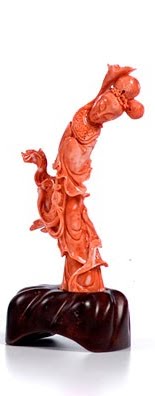
Coral carvings craving


It clearly isn't just me who thinks these coral carvings of the Chinese Goddess Kuanyin and other figures are very desirable judging by the number of bids at auction and the prices achieved over their estimates. Given the destructive environmental considerations, I would be loathe to buy anything new, and the same applies to ivory sculptures, but I suppose I do contribute to any trade in these resources when I state my liking, and I'm not entirely sure what the answer is. All of these items shown here are manufactured in China, but all are for sale in the United States.

As a child I remembered, (perhaps incorrectly) that they were sold in great quantities at quite reasonable prices in the large Chinese store in Hong Kong, The Chinese Merchandise Emporium, (better known as the "Commie Shop", to reflect it's Mainland roots pre-Deng Xioping's "To get Rich is Glorious" second revolution).

On a recent visit to Hong Kong I tried to find the old Commie Shop, but it has long since given way to something much more entrepreneurial, which would have pleased Father Deng. A similar shop, Chinese Arts & Crafts did have coral pieces, on a much grander scale than those I'm showing. The prices, like the pieces, were staggering, in the hundreds of thousands.

How do you weigh up ethical versus beauty issues?

Thursday, 15 July 2010

In the family


This is the temple of the Khoo Kongsi, (the Khoo clan), in Georgetown, Penang. It was built between 1894 and 1906 and is considered the most ornate clan temple outside of China. From the last picture you can see how it dominates the clan housing around it. Kongsi has a number of connotations, including the less savoury one of triads, (or mafia). When we lived in Malaysia as children my mother would refer to a doctors' partnership as a kongsi, as it was quite widely used in references to businesses. The strength of Chinese communities both socially and economically has been attributed to the concept of the kongsi, or keeping it in the family. Jewish communities prospered in a similar fashion.

As noted here, from Wikipedia:

The system of kongsi was utilised by Chinese throughout the diaspora to overcome economic difficulty, social ostracism, and oppression. In today's overseas Chinese communities throughout the world, this approach has been adapted to the modern environment, including political and legal factors. The kongsi is similar to modern business partnerships, but also draws on a deeper spirit of cooperation and consideration of mutual welfare.


It has been stated by some that the development and thriving of Chinese communities worldwide are the direct result of the kongsi concept. A vast number of Chinese-run firms and businesses were born as kongsi--many ending up as multinational conglomerates. In the Chinese spirit, derived in large part from Confucian ideals, these kongsi members or their descendants prefer not to boast so much of their wealth but to take pride in earning worldly and financial success through their work ethic and the combined efforts of many individuals devoted to group welfare.

In Thailand today a number of large families control huge swathes of economic life in the kingdom, and although they are Thai now, with Thai names, their origins are distinctly Chinese - the so-called Thai Chinese. Despite their huge wealth, they usually live modestly, although in the younger generation, this is beginning to change, as the scourge materialism takes control.
Related Posts Plugin for WordPress, Blogger...